3/31/11

Circle Doo-Wahs

How to mold large circular frames, commonly known as "Tondos". Actually, the paintings are Tondos, so the frames would be Tondo frames. On the end is a wooden block, adjustable and lockable with thumbscrews. On the bottom of the block, a 3/16" brass pin, which is inserted into a hole in a block at the center of the frame. The router is a Porter-Cable, with a plunge router base. The rods are 5/16" steel, lockable to the base with thumbscrews. At the left of the base, there is a brass "flange" I added to provide additional support for the rods.
 
Here, a frame in process. At the upper right, the block at the center of the frame. This is the one tool in my studio that does not have some sort of dust collection system. So, noisy, and messy. While I'm typing this, the idle part of my brain is thinking of how I can add dust collection, and the power cord all coming down from on high. Hmmm.

There is a "scary" aspect to using a router on a 50-60 inch diameter frame, mostly to do with keeping the noisy little beast stable. Now I'm thinking of how to add circular capability to my shaper, and power feeder. Hmmm, again.


The floor in the top photo, shows the detritus of gesso, and various sealers, toners and paints, from when the frame was too big for the spray area, where I generally make my messes.
 
Here is a shot of the build-up of gesso, sealer, toner and what not on the turntable in the spray area. It probably weighs twice what it did when I built it. I included, as a client was fascinated by the abstract quality of the accretions.

3/16/11

More design

Cutting out the outside of the frame (see previous post) on a jig saw.

And, starting to carve.

3/9/11

Design Evolution

I'm working on a small frame, with a somewhat "Art Nouveau" feel to it. I did some preliminary sketches, on paper, but shown above, I'm drawing with charcoal on what will eventually, be the frame. I have purposely not tried for complete symmetry; but just drawing both sides, rather than taking a tracing, flipping and transferring it.

Here, I'm approaching what the final design will be, though refinement of details will happen during the carving phase. The frame is butt joined using floating mortise and tenon (biscuits) construction.

3/7/11

Cutting circles

Above, my jig for cutting circles on the bandsaw. That is a 3 inch diameter circle being cut, and I've used it to cut octagons into circles for "tondo" frames, of 50 some inches in diameter.

Above, showing the the brass plates that slide under the fence, holding the jig in place. The two bolts act as adjustable stops, depending on blade size and position.


This image shows the bottom of the jig. The strip that rides in the miter slot of the saw, and the thumb screws that hold the sliding piece that adjusts for the size of circle desired.


Here, the jig is lined up with the blade of the saw, and the brass pin that the stock is centered on is visible. A hole is drilled in the bottom of the stock, as in the top photo, or, in the case of a tondo, a cross piece is screwed to the frame, and a block the same size as the frame is added for the machining operations, see below. The sliding element is positioned with the pin at half the diameter needed, stock affixed, then the jig is slid into the moving blade, and against the stops. Once stopped, the stock is turned into the blade.

Above, a tondo in process. The same pin hole is used to rough cut the tondo on the band saw, as well as a guide for a router.

1/29/11

Quanity required

I don't do comments here, though I am responsive to email questions. How does one figure the amount of leaf for a gilding job?

First, figure the leaves needed to cover a three inch, gold, length of the molding, (overlaps), multiply by four, then multiply by the number of feet.

A 30 + 40, = 70,  3.5 inches wide, + 7, divided by 6 = 12.83 = 13 feet. If it takes five leaves to cover one 3 inch length, (overlaps), because of the depth of the molding, and 3D ornament or carving, multiply by 4 ( the no. of leaves in a foot), then the no. of leaves to cover the whole molding. 13 x 4 = 52 x 5 = 260. A little over estimation is good, though I have  done some frames where my estimating was right to the leaf, leaving me just a few for some sort of insurance. With gold, I usually figure my needs, and seldom with metal, as there is usually enough on hand, and the economics are different.  Framers all round up at some point; for me it is a half foot.

Happy gilding! I tend to water gild gold in the evening, after dinner, after a drink or so, as I am calmer and less bouncy. Machining and carving are usually done in the day; toning is a day time, frenetic dance. I can carve in the evening, but running machines is a daytime, sober, scary activity, and I have 9 and 7/8ths fingers to show for it. You can screw up at any time, so pay attention, and listen; if it doesn't "feel" right, don't, relax, look at it critically. Fingers are  ...  good!

I've been doing proposals for 19th. c. reproduction frames, thus the picture.

1/18/11

Frames of another ilk.

I'm working on some frames for windows; restoring double-hung sash for a 1912 "four-square" house for a small "Green" organization. These sash are about 100 years old, and are easily restorable to the same functionality of any modern window. Add a storm, and they are completely competitive with any modern glazing method. And, in 50-60 years, they can be restored again; the weights will still be there, the rope can be replaced; the glass can be replaced, paint and putty, replaceable. The way these older windows are assembled and the maturity of the technology involved is just amazing. Unlike furniture, many of the sash are not glued at the joint; just pinned, and then the glazing, points and putty hold it all together as an integral unit.

I fear that many of the newer style windows, with the spring loaded balancing mechanisms, are going to be unrepairable in the future, due to lack of parts. With a traditional sash, weights can be recast; rotted out elements can be repaired or replaced; a mature technology, and the "eyes of your house".

1/14/11

Clearing alleys?

In an unprecedented action, the city has sent in an end loader to clear alleys so the garbage trucks can get through. This is the alley behind my house. This has never happened before, never!

1/10/11

Small Blessings

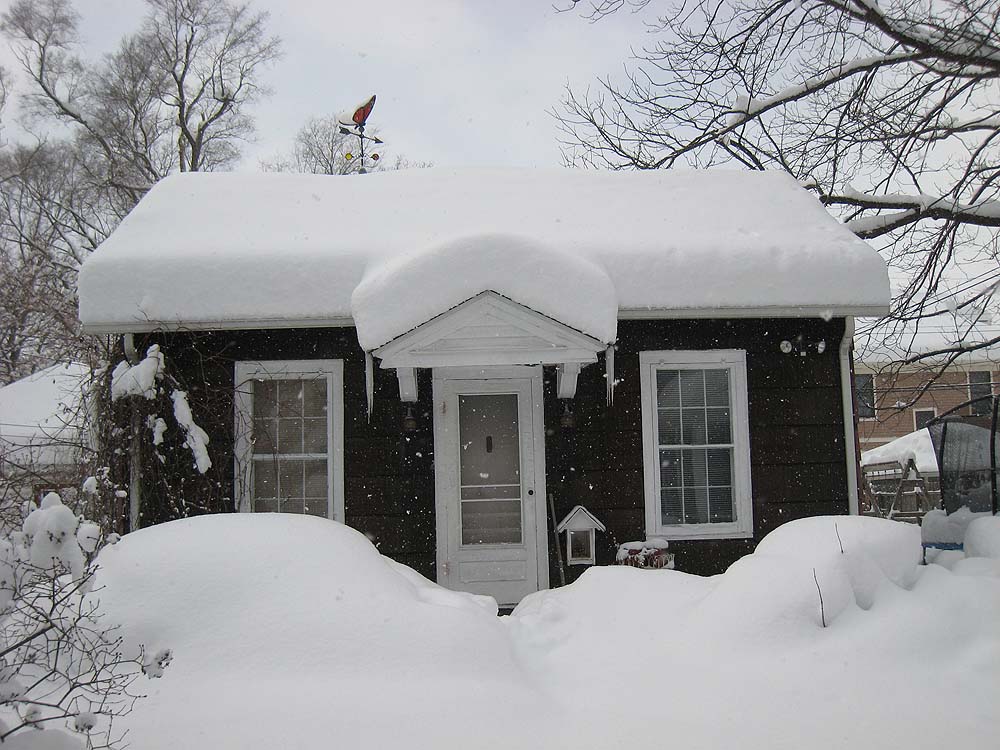
At about 4:00 PM Saturday afternoon, the wind shifted slightly, from NW to N, the skies cleared, and the lake effect "snow monster" ceased here in South Bend. Total snow was 38.6 inches from late Thursday morning to Sat. afternoon. For the final 24 hour period, a new record was set, 25 inches. More snow than the famous 'Blizzard of 78", which was a systemic snow, and hit much of the mid-west.

Chicago, summertime.

1/8/11

More of the Snow Monster

The Studio

The walk to the street.

My mini-van?
It's about 2:30 in the afternoon, in one of the brief lulls in the ongoing snow. Lake effect snow is predicted to continue until 7:00 AM, Sunday morning, a little more than 16 hours from now. If the snow continues at the rate it has fallen for the last 20 hours, we will get our average, yearly snowfall in one 50 some hour period; approximately 80 inches. Even for South Bend, this is an unusual "Snow Monster".
At the end of December, we had a mid-winter thaw, that produced temps in the 50s, which melted all of our previous snow. We started a new snow layer on Thursday; Friday night, the monster really kicked in. Ahh, winter.

Snow Monster Redux


The snow monster drops 20-30 inches, depending on where you are in the bands, which are holding steady as in the radar shot. The monster has another 20 hours to work its magic, with snow of 1-2 inches per hour expected. The bottom is an image of what a snow squall looks like; sometimes these produce zero visibility. Now, back to trying to clear some paths.

12/27/10

Context

A visitor looks at a self-portrait by Mexican painter Frida Kahlo during the first day of an exhibition of Frida Kahlo and Diego Rivera from the Gelman Collection at Pera Museum in Istanbul, Turkey, 22 December 2010. The exhibition will be open until 20 March 2011. EPA/TOLGA BOZOGLU.

The above is from Artdaily.org, here, Frida Kahlo.

I like that a lot of the images Art Daily uses  show the actual exhibition, with some context.

The frame is very nice, as well. 

12/11/10

Civil War


Above, the monument to the Confederate soldiers who died at the Civil War prisoner of war camp at Chicago, Camp Douglas. It stands atop a slight "hill", known as the Confederate Mound, where between 4454, the official number, and possibly as many as 6000 Confederate Prisoners of War are buried in concentric circles. This was a first visit for me, and the rain, and deep slush of the mound, did not invite prolonged picture making, and I also wanted to see this:


Statue of Lincoln in the Gettysburg pose; a copy of a sculpture in Illinois. The stripes are from the rain, which at this point, was plentiful.  Both the statue and the Confederate Monument are in Oak Woods Cemetery, South side of Chicago. 

Later, better images, though the monument, as an overall, with the fog and rain, seems appropriate for a cemetery visit.
 

12/9/10

Rant


A small rant on looking, and context, all probably said before, but needing said again.

It's nice to see people in an actual museum, looking at art in frames, hanging on a wall, just like it was meant to be. Too many curators, art students, and even dealers, look at art on computer monitors, in books, or sometimes, still, transparencies, where the art is torn from it's frame and any context, and the object quality of it is completely lost. No texture; just flat and flat. This out of context viewing leads to artists who labor long periods on the painting, and then finish it by "framing" with some ill-fitting, shoddily finished, wood strips, haphazardly nailed to the stretcher bars. A very obvious comment on the importance the artist attaches to his or her work.

I think a disservice to art is done by art professionals who think naught of tearing the art asunder from its context, and base all sorts of curatorial decisions, on the sundered remains. Is the frame, and some context, necessary? Obviously, I believe so, though, being an artist who works in the medium of the picture frame, it would seem I'm biased. More later, and a "snarky" comment; if you don't want to frame your art, become a sculptor.