4/22/11

An Old Painting


An older painting of mine, for which I just found a not very good slide of. I think the bright areas at left and right are from the lights rather than a part of the painting, but my visual memory is mainly of the overall color purple. The frame is a variation on, and refers to a "naive" style frame from the early 19th. century. See here. The painting is small, and in fact, the owner has it on a bookshelf, as a "standing" frame, as the sides are flat.

The original is a frame I've repeatedly come back to, as a source for some modern variations, and I've also done some that are somewhat faithful to the original. Here, a modern version in real wood, gasp!, white ash, stained a little.


That one frame has been a very fecund well for me, and here is an example of the variation being only in the color. The link has some other images of the frame.

4/14/11

Frame for a Civil War Icon


The Last Meeting of Lee and Jackson
Oil on Canvas, 12'10 3/4"  x  9' 7".

I've long been acquainted with this image, one of the "iconic" images of the American Civil War. The image above is from a book, "Mine Eyes Have Seen the Glory, The Civil War in Art", by Harold Holzer and Mark E. Neely, Jr., wherein I first saw the painting in its frame. It's great to see art in some context ... alas the above image has been truncated. See below:

The second image is courtesy of Thomas P. Crowther, Director, The Charleston Renaissance Gallery, who graciously e-mailed me a copy of the image from their archives. They owned the painting in the late eighties, and were responsible for the rescue and restoration of the standing outer frame. The base has been replaced, visible as a variation in the wood color. The painting is now part of the collection of The Museum of the Confederacy, Richmond, VA.

And now, I shall curmudge. 8-)

By chopping off the eagle, one loses a good bit of  the wonderful Victorian excess in the frame, though to the books credit, most of the frame was included. And, they included the size.

My complaint is that the majority of imagery of Art has no context, no frame, and quite frequently little information as to size and medium. Usually, size is only for the canvas, or image, and of course, the frame is once again slighted. However from some images on the web, with people in front of the painting, context,  I suspect that the size above is actually for the outside of the frame, as if the canvas were that big, the frame would be close to 20 feet in height. Not inconceivable, but large.  I will check on that.


Addendum 1.: I completely forgot to include the artists name: Everett B D Fabrino Julio (1843-1879). He studied in Paris and Boston, and so was probably acquainted with the Pre-Rapahealite Brotherhood, who had a taste for achitectonic frames as well. A somewhat tragic figure, who died young, never having sold this painting. It did, however, go on tour, an alternate income source for many artists in the 19th. century.

Addendum 2.: Mr. Crowther, see above, has responded with a size for the canvas as: 108 x 72 inches, or nine feet high and six wide. Height precedes width.

3/31/11

Circle Doo-Wahs

How to mold large circular frames, commonly known as "Tondos". Actually, the paintings are Tondos, so the frames would be Tondo frames. On the end is a wooden block, adjustable and lockable with thumbscrews. On the bottom of the block, a 3/16" brass pin, which is inserted into a hole in a block at the center of the frame. The router is a Porter-Cable, with a plunge router base. The rods are 5/16" steel, lockable to the base with thumbscrews. At the left of the base, there is a brass "flange" I added to provide additional support for the rods.
 
Here, a frame in process. At the upper right, the block at the center of the frame. This is the one tool in my studio that does not have some sort of dust collection system. So, noisy, and messy. While I'm typing this, the idle part of my brain is thinking of how I can add dust collection, and the power cord all coming down from on high. Hmmm.

There is a "scary" aspect to using a router on a 50-60 inch diameter frame, mostly to do with keeping the noisy little beast stable. Now I'm thinking of how to add circular capability to my shaper, and power feeder. Hmmm, again.


The floor in the top photo, shows the detritus of gesso, and various sealers, toners and paints, from when the frame was too big for the spray area, where I generally make my messes.
 
Here is a shot of the build-up of gesso, sealer, toner and what not on the turntable in the spray area. It probably weighs twice what it did when I built it. I included, as a client was fascinated by the abstract quality of the accretions.

3/16/11

More design

Cutting out the outside of the frame (see previous post) on a jig saw.

And, starting to carve.

3/9/11

Design Evolution

I'm working on a small frame, with a somewhat "Art Nouveau" feel to it. I did some preliminary sketches, on paper, but shown above, I'm drawing with charcoal on what will eventually, be the frame. I have purposely not tried for complete symmetry; but just drawing both sides, rather than taking a tracing, flipping and transferring it.

Here, I'm approaching what the final design will be, though refinement of details will happen during the carving phase. The frame is butt joined using floating mortise and tenon (biscuits) construction.

3/7/11

Cutting circles

Above, my jig for cutting circles on the bandsaw. That is a 3 inch diameter circle being cut, and I've used it to cut octagons into circles for "tondo" frames, of 50 some inches in diameter.

Above, showing the the brass plates that slide under the fence, holding the jig in place. The two bolts act as adjustable stops, depending on blade size and position.


This image shows the bottom of the jig. The strip that rides in the miter slot of the saw, and the thumb screws that hold the sliding piece that adjusts for the size of circle desired.


Here, the jig is lined up with the blade of the saw, and the brass pin that the stock is centered on is visible. A hole is drilled in the bottom of the stock, as in the top photo, or, in the case of a tondo, a cross piece is screwed to the frame, and a block the same size as the frame is added for the machining operations, see below. The sliding element is positioned with the pin at half the diameter needed, stock affixed, then the jig is slid into the moving blade, and against the stops. Once stopped, the stock is turned into the blade.

Above, a tondo in process. The same pin hole is used to rough cut the tondo on the band saw, as well as a guide for a router.

1/29/11

Quanity required

I don't do comments here, though I am responsive to email questions. How does one figure the amount of leaf for a gilding job?

First, figure the leaves needed to cover a three inch, gold, length of the molding, (overlaps), multiply by four, then multiply by the number of feet.

A 30 + 40, = 70,  3.5 inches wide, + 7, divided by 6 = 12.83 = 13 feet. If it takes five leaves to cover one 3 inch length, (overlaps), because of the depth of the molding, and 3D ornament or carving, multiply by 4 ( the no. of leaves in a foot), then the no. of leaves to cover the whole molding. 13 x 4 = 52 x 5 = 260. A little over estimation is good, though I have  done some frames where my estimating was right to the leaf, leaving me just a few for some sort of insurance. With gold, I usually figure my needs, and seldom with metal, as there is usually enough on hand, and the economics are different.  Framers all round up at some point; for me it is a half foot.

Happy gilding! I tend to water gild gold in the evening, after dinner, after a drink or so, as I am calmer and less bouncy. Machining and carving are usually done in the day; toning is a day time, frenetic dance. I can carve in the evening, but running machines is a daytime, sober, scary activity, and I have 9 and 7/8ths fingers to show for it. You can screw up at any time, so pay attention, and listen; if it doesn't "feel" right, don't, relax, look at it critically. Fingers are  ...  good!

I've been doing proposals for 19th. c. reproduction frames, thus the picture.

1/18/11

Frames of another ilk.

I'm working on some frames for windows; restoring double-hung sash for a 1912 "four-square" house for a small "Green" organization. These sash are about 100 years old, and are easily restorable to the same functionality of any modern window. Add a storm, and they are completely competitive with any modern glazing method. And, in 50-60 years, they can be restored again; the weights will still be there, the rope can be replaced; the glass can be replaced, paint and putty, replaceable. The way these older windows are assembled and the maturity of the technology involved is just amazing. Unlike furniture, many of the sash are not glued at the joint; just pinned, and then the glazing, points and putty hold it all together as an integral unit.

I fear that many of the newer style windows, with the spring loaded balancing mechanisms, are going to be unrepairable in the future, due to lack of parts. With a traditional sash, weights can be recast; rotted out elements can be repaired or replaced; a mature technology, and the "eyes of your house".

1/14/11

Clearing alleys?

In an unprecedented action, the city has sent in an end loader to clear alleys so the garbage trucks can get through. This is the alley behind my house. This has never happened before, never!

1/10/11

Small Blessings

At about 4:00 PM Saturday afternoon, the wind shifted slightly, from NW to N, the skies cleared, and the lake effect "snow monster" ceased here in South Bend. Total snow was 38.6 inches from late Thursday morning to Sat. afternoon. For the final 24 hour period, a new record was set, 25 inches. More snow than the famous 'Blizzard of 78", which was a systemic snow, and hit much of the mid-west.

Chicago, summertime.

1/8/11

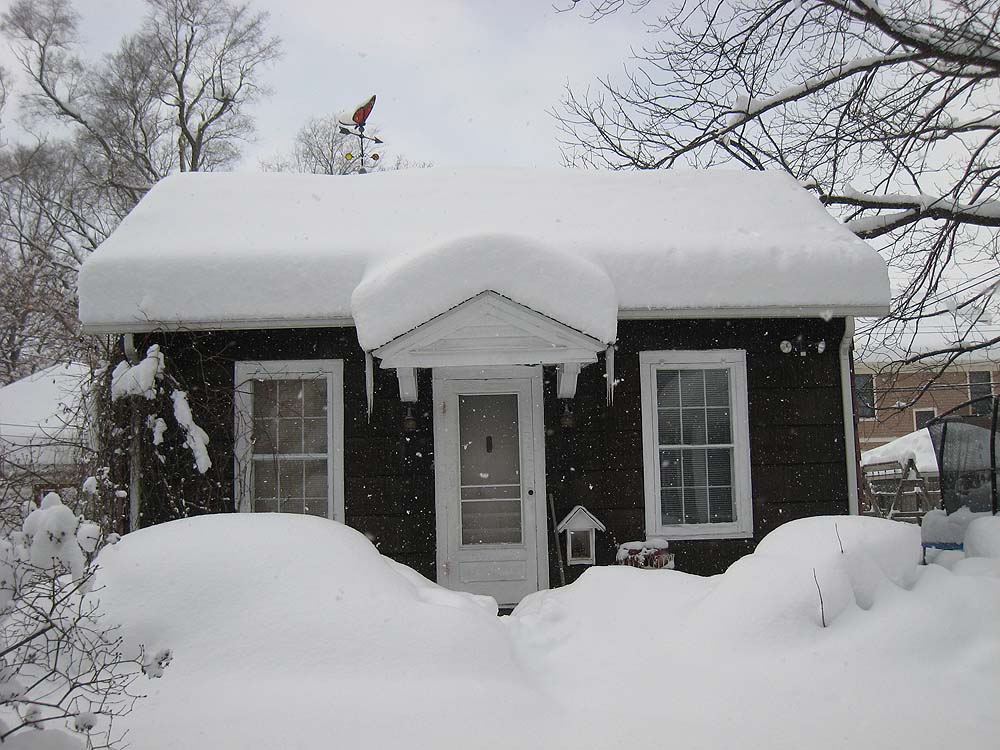
More of the Snow Monster

The Studio

The walk to the street.

My mini-van?
It's about 2:30 in the afternoon, in one of the brief lulls in the ongoing snow. Lake effect snow is predicted to continue until 7:00 AM, Sunday morning, a little more than 16 hours from now. If the snow continues at the rate it has fallen for the last 20 hours, we will get our average, yearly snowfall in one 50 some hour period; approximately 80 inches. Even for South Bend, this is an unusual "Snow Monster".
At the end of December, we had a mid-winter thaw, that produced temps in the 50s, which melted all of our previous snow. We started a new snow layer on Thursday; Friday night, the monster really kicked in. Ahh, winter.

Snow Monster Redux


The snow monster drops 20-30 inches, depending on where you are in the bands, which are holding steady as in the radar shot. The monster has another 20 hours to work its magic, with snow of 1-2 inches per hour expected. The bottom is an image of what a snow squall looks like; sometimes these produce zero visibility. Now, back to trying to clear some paths.

12/27/10

Context

A visitor looks at a self-portrait by Mexican painter Frida Kahlo during the first day of an exhibition of Frida Kahlo and Diego Rivera from the Gelman Collection at Pera Museum in Istanbul, Turkey, 22 December 2010. The exhibition will be open until 20 March 2011. EPA/TOLGA BOZOGLU.

The above is from Artdaily.org, here, Frida Kahlo.

I like that a lot of the images Art Daily uses  show the actual exhibition, with some context.

The frame is very nice, as well.