5/26/14

Basswoods

The basswoods have leafed out, bracks, and the flowers to be, showing. And now, for something a little different:


The above was taken just at the end of civil twilight, lighted by a sodium vapor street light. I have my little camera set to use 1600 ISO if needs be. The high ISO has brightened the sky. The leaves to the right of the building are actually shadows, from the leaves near the center. I am quite impressed by the quality and capabilities of newer digital cameras, and though this is a relatively high end machine, it is still pocketable. Canon S110.

And, I like the picture; might be a fondness for yellow ochre?


5/10/14

Fret sawn ornaments

A design under the influence of the Middle East. "Scherezade". The ornament is a simple organic ribbon, repeating in and out. I use a fret saw to cut the basic shape, which is then glued to the frame, and carved.

The fret saw and an ornament block. I like spiral blades for this work, though I find they cut better with a straight approach, as though they were regular blades. Spiral blades, are in theory, omnidirectional. The saw is mounted on a small sheet of plywood, which is then clamped to the bench. When I can, my tools are hooked to dust collection, in this case to my shop vac.

The block is taped on both sides and then it is "bread sliced" into the thin ornaments. The tape is to hold the thin design together.


The corners being wasted for the ornaments. The cyanacrylate glue is for the sometimes "holiday" in the regular gluing, with hide glue.


Here, marking lines for the carving edges. I use my finger as a fence to draw the lines. And here, a finished version: Frame Notes: Fret Sawed Ornaments


5/1/14

Some more process photos.


Applying bole. Bole is a very fine clay, in various earth colors, that when mixed with hide glue becomes the base layer and adhesive for water gilt gold. The color above is a mix, to match the color on the original frame.


Water gilding. The surface is wet with the "gilding liquer", water and some alcohol to break the surface tension. The polished bole is wet thoroughly, and the gold leaf is applied by picking it up with the tip, that wide flat brush, and almost slapping it on to the wet surface. To make the tip grab the leaf, I rub a tiny amount of vaseline on the back of my left hand, then lightly brush the end of the tip over my hand before grabbing the edge of the leaf with the tip. Sounds simple enough.


When the gilt areas are dry, they are burnished using an agate tool. To test for dryness, the surface is tapped with the agate; when a hard click is heard, the surface is dry. Trying to burnish wet just destroys the leaf. Two different shaped burnishers on the bench.

Burnished gilding and stained wood, with the color sample to match to. Waiting for the finish coat.


4/21/14

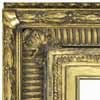
An unusual frame.

Actually, not that unusual , though this style, where the corner escutcheon is carved is unusual. I did quite a few of these early in my career, in mahogany and black walnut, though stopped pushing them as the labor intensity tended to make it hard to make a profit. I'm doing a reproduction of a damaged existing frame, with carved, water gilt and burnished corner escutcheons, over stained and finished basswood. Basswood, though usually gessoed, then finished, actually is an attractive wood in itself. MOMA, NYC, has a few examples of stained and finished basswood frames.
Photo above, I'm using an oscillating saw to rough out the shape for the corners.
A corner before gessoing. After roughing out, small carvers rasps were used to refine the shapes.

Another photo before gessoing.

The corners masked off, and the first few coats of gesso applied. Normally I spray gesso, but in this case, all of the coats will be brushed. The first coat was scrubbed in with a toothbrush until almost dry, to eliminate pinholes.

Scenes from NYC, and beyond.


Manhattan receding aboard the Staten Island Ferry. If it's warm enough, outside as the Ferry crosses the harbor is the fun spot to be. Some of the ferries have outside decks; some require you to stand on the back deck, above the props, if you would like to be outside. My wife and I both enjoy being out in the sights, smells, and breezes.

The Falcon God is not happy, not happy, Bob. As my Jewish relatives say, "what a Punim". From the Metropolitan Museum of Art.


And, two more "roadside" snaps. It may be part of my whole approach to photography, and art; learn the foundation, the basics, then feel free to wing it. I spent a lot of time with an unmetered camera, no light meter, just guesstimating exposure. It's far easier to do that today with a digital camera, but then as now, a multitude of sins could be fixed in post processing. The roadside snaps are done from a moving vehicle, night, obviously, along one of the interstates here in the US. The camera is set to manual focus, infinity, program, at 3200 ISO, with image stabilization on. I have the camera on, and as we approach an interchange, I put the camera against the side glass, with my hand as a light scrim, blocking reflections from the dash lights; then just press and hold the shutter release, letting the camera take a number of shots. The quality of the light against the trees is what intrigues me. I have some other kind of images, related, though not the same, that I want to do. All involve the very edge of the cameras ability to record, and again, the light at this point is very interesting. I've even made some prints from some of these.


4/15/14

The Ides of April

Charles Wilson Peale (April 15, 1741 - February 22, 1827)


The Artist in His Museum
Pennsylvania Academy of Fine Art


One of my favorites of early American Artists, and well worth investigating. Founder of two Art Academy's, including the Pennsylvania, and America's first museum, he was 81 when he painted the above.

In Roman times, the "Ides of March" was a time for settling debts. Here in the states, calling the 15th. of April the "Ides" seems appropriate.

3/17/14

Unusual War Memorials

I had occasion to be on the Notre Dame Campus the other evening, with a little time to wander. I was familiar with Chaplain Corby's absolution, but didn't know there was a statue of him on campus. A building on campus and a street, in South Bend, boulevard, actually, are named for him. After the war he served as President for two separate terms of the University.
Chaplain William Corby giving General Absolution to the Irish Brigade on the second day at Gettysburg. This is the second of two statues of Fr. Corby, the first is at Gettysburg, mounted on the rock from which he gave absolution. I believe the statue ages him; he was 29 at the battle of Gettysburg.
Next, a side door of The Basilica of the Sacred Heart on campus. Above the door, left is Joan of Arc, right is St. Michael, the Archangel. There are two bronze plaques with names besides the doors, with 3D heads below, one of whom appears to be wearing a WWI style helmet. This is a memorial to Notre Dame students who died in that conflict.


" “[I]t might be of interest to some that all the statues were done in artificial stone, a cement mix consisting of Portland cement, white cement, silica, marble dust, and for slight coloring, Burnt Siena powder, a warm brown color. The figures had to be made in clay from which a mold was formed for pouring the cement mix. Father O’Donnell would not consent to have the figures carved out of limestone – too slow and expensive a process. As it was, the niches on campus buildings had been neglected for too many years. The World War I Memorial had the names of Joan of Arc and St. Michael carved in Gothic script below the niches in 1924, empty niches, and now we were in the middle of World War II when John Bednar filled those two niches with their namesakes!"
A quote from Fr. John Bednar, sculptor of the staues in the niches above.

3/12/14

Blur and Dark


107th. Regiment Memorial, NYC. Park Avenue and 67th. Street, NYC

This was taken from a moving taxi during my recent excursion to NYC. I like it very much; the soft gray tones, slightly blurred, slightly dark. Pictures taken from moving vehicles; pictures taken in available darkness:


A few more.


Taken from a moving vehicle at night. I'm very intrigued by it. There is a certain color to trees illuminated by overhead lights along highways in the US.

All of these images have received no "work", they are, as much as the interwebs will allow, as from the camera.


3/2/14

Lumber

Lumber, 6/4, 5/4, 4/4. (hardwood lumber is measured rough, before milling, so 6/4 is 1 1/2" thick, milling out to 1 1/4" thick. Similar to the 2 x 4 framing lumber that is actually 1 1/2". X. 3.1/2" On an overhead rack in the studio. This is for one frame, four feet x eight feet. By storing it on an overhead rack with air spaces around each piece it can acclimate to my studio conditions, and dry more if needed. Tomorrow, I'll do some moisture readings to see where I'm at, in moisture content terms. I generally buy lumber as needed, though there is always an accumulation.
A corner of the studio, the wall where the lumber leans; some black walnut boards, birdseye maple, basswood, oak. All extras from projects past. I've been trying to eliminate the really small stuff, but it's hard to cut and burn a piece that might be useful some day. This corner used to be twice as full; As long as I don't think about it too much.
Another overhead rack that holds the ten foot and longer pieces; in the back is a black walnut board, 8/4, 12 or 14" wide, and I think 10' long, maybe more. A remnant of my rocking chair project. I think I bought a lot, as those boards had a subtle purple cast, like the wood had been air-dried, or kiln dried by somebody with a real feel for the wood. That purple color is rare in black walnut; more common when the lumber is air dried, though not a given. Like my post on popple, and rainbow poplar, a few back, cutting open a board can be magic. Jame Krenov, and George Nakashima have both written of it in their books on woodworking.

Infinite Winter

Another few inches of snow; poor bears. News reports have winter lingering well into "spring". No breeze this morning, so the 15 degrees F felt almost balmy. This helps as well:
Yesterday I got in the lumber for a large "Victorian Excess" style frame, so soon some posts on framing.
And now for some technical minutia. I've just set the timer on my iPhone; sausages grilling on the gas grill, just outside the enclosed back porch where I'm sitting in front of that fire, above. The fire is in a Victorian era pot belly stove, that has had the ash pit filled with fire brick and ash so it can be used as a fireplace. Typing this post on a iPad Mini. The photos I took a few minutes ago have been importd into the Mini, processed in Photogene, and now posted.
(Oh, time to turn the sausages. Sausages are being mentioned, because eating a lot helps with winter.)
This is my first iPad; I've had a Kindle Fire, but the iPad feels more like a real computer rather than an entertainment device. The program I'm using to do this post, Blogsy, makes it very easy to post. That is something I could never do with the Fire. Probably possible, but steep learning curve. The photo editor, Photogene, is full featured, very inexpensive ($.99), and does something the much more touted programs, iPhoto, and Snapseed don't, is allow resizing of images for different purposes. Some complain that the virtual keyboards are difficult to use, but not being a touch typist, I find I'm faster than on my desk keyboard.
Email, of course, but I'm also doing word processing that can be easily linked to my desk machine. There are still some things that the desk machine excells at, but I'm finding more projects that I can do on the tablet. The few days I recently spent in NYC, with only the tablet, did not seem under powered computing wise. Entertainment; movies are great; the small screen, close, is surprisingly effective. Magazines and illustrated books, when done properly (still an issue for many publishers), especially the ability to zoom and change font sizes, let alone carry a vast quanity of material, and have access to an infinite more. I can even go to my local library and borrow books when I'm not in town. Interesting, warmed by the most ancient of technologies, while working on one of the most recent.

2/23/14

Manhattan, and I should get out more.

My wife persuaded me to go to NYC this last week ( I'm a reluctant traveller, especially flying ), and a good time was had. I think of Manhattan as Disney World for adults, though even more expensive. We were focused on museums this trip, specifically the "replica" of the 1913 Armory show at the New York Historical Society. A nice show, and great to see in person some of the icons from the original show. Then, my wife showed me the society's open storage. As I say above, I should get out more; wonderful to see objects not usually displayed, the Daniel Chester French maquettes for the Lincoln Memorial in Washington D.C. were a delight, as were several under paintings by Asher B. Durand, the Hudson River School painter. Being very technically oriented, I do enjoy seeing the working processes of other artists. We skipped the Guggenheim's discombobulation, and managed the Whitney, the Met, and the Museum of Art and Design, MAD. I was especially intrigued by a show at MAD, Post Digital, showcasing works of artists using digital technology, 3D scanners, printers, CNC machines, weaving machines, to produce very mature art. I have only a few photos of the art; I was more focused on the city itself, though with my interests showing. 8-)


Flying, approaching NYC.


Times Square


City dogs, with their coats and boots.


For me, a quintenssential NYC vista.


Overlooking Columbus Circle. To the right, Central Park.


A monument to the Soldiers and Sailors of the Battleship Maine.
Located at Columbus Circle, and the south edge of Central Park.


Another monument, seen and photographed from a taxi, stopped briefly beside it. West edge of Central Park, and Midtown. From the helmets, WWI.


And a view of Lincoln Center, from our hotel room.

2/16/14

Sunday afternoon.

A solitary crow, though many of his colleagues were chattering in the immediate area. Crows are very wary of my walking near them, flapping off if I get close.
The snow pack is settling, and even melting a little, though it is still very cold; well below normal temps for this late in the season. Our back yard is still drifted over; to take the garbage to the can in the alley, I walk out to the street and around the block and up the alley. The flowers were almost covered fairly recently.
And now, from my wifes collection, On Bee We Depend, by Catherine Peet. The frame, a found object, was decorated by the artist, including bees wax panels and a resin embedded bee as the top central ornament.