10/24/12

Photography and Memory

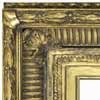
Image of a frame I made about 7 years ago. I've never liked the photo, and because of that, not liking the photo, I've had somewhat negative feelings about the frame itself. The above is my latest attempt at potatochopping the image into something I like, and I'm still not satisfied. This previous weekend, I went to an exhibition on the art of George Ames Aldrich at the Brauer Museum of Art, Valparaiso University. There, I saw this frame and another of the same pattern on two Aldrich paintings. In person, I liked the frames far more than I had remembered. I have noted this as a phenomenon; I'm never quite pleased with my work until some time has passed. Then, an opportunity arises for me to see the work again, and with a few exceptions, I'm far more pleased with how the frames look than memory served.

Being self-critical is important for the quality of the work, and is a part of the process. Near the end of the carving, I'll hang the frame in viewing position, walk away, do other things, so I can see the frame with fresh eyes. Changing which leg is up is a part of that, and often leads to refinements, and catching subtle errors.

And it is enriching for my ego, to be looking at a piece of art, think it's nicely framed, and then recognize it as my own work. I knew that in an Aldrich exhibit, there would be some of my frames, but these were a surprise, as I have often done frames without ever seeing the actual art. In this case, I actually had to study the frames for awhile, including looking at the label to see ownership, before deciding that, yes, they were mine.


10/14/12

Curmudging

Early Sunday Morning
Edward Hopper
Whitney Museum of American Art

My comment in the previous post needs some elaboration. It has become a cliche of art speak to compare certain kinds of images to the work of Edward Hopper. I, personally am offended for Hopper's sake, as it seems dismissive of him that any "hack job" can be compared to his work. In much the same way that certain aspects of Andrew Wyeth's work have been copied into being a cliche, the rustic aspects of rural decrepitude were for Wyeth, portraits of the people who inhabited that decrepitude, and these were people he was intimately involved with for long periods of time, not just some rustic ruin he happened upon.

In other news, the Metropolitan Museum of Art, NYC, has started putting online, some of their publications, with some of the out of print items available for download as PDFs. Of interest to framers is this one: Italian Renaissance Frames

A resource to be explored.

And from Richard Christie, Framemaker, a link to another resource: The Frame Blog

10/2/12

On Art

Approaching Fog

Over on TOP, here, and here, there have been several posts with some good commentary about the work of Doug Rickard in the book "A New American Picture". His work rephotographs and manipulates Google street view images.

Some of my thoughts:

Why is every slightly “lonely” street photo compared to Edward Hopper, when the compared work has none of the psychological or emotional investment Hopper imbued his work with?

I have a pretty loose definition of Art; it can be built on a foundation of 10,000 hours of technical skill and craft, or not. It can come from the hand of a child (Picasso had some thoughts about that) or even the wave action of a great body of water, but it is transcendent of it’s material origins.

I think it’s Art, therefore it is.

As to Rickard's work, I’m ambivalent about the concept, and thus the work, because it is so removed from the actual reality, and seems emotionally distant. Quite the opposite of Edward Hopper. I have the same response to much marble sculpture; it rarely is the hand of the artist who designed the maquette. Michelangelo's David is a notable exception. I guess I like more personal involvement, even if the "hand" is Lake Michigan sculpting a piece of driftwood.
But, as I say, there are some good thoughts on the nature of personal involvement in Art.

I reserve the right to be completely inconsistent. 8-)

Bron


9/21/12

Today, Sept. 21

Today, amid the usual bloody detritus of human history, a small brightness. In 1937, The Hobbit, J.R.R. Tolkien, was first published in England.


Dust cover, designed by Tolkien, for the first edition.

9/20/12

Some Attic Windows

I haven't posted any attic windows for a while, so ....


 Front and back views of a Swiss chalet inspired house.


And just across the street. The "Swiss" house was built for an executive at Studebaker. No info on the other house, a conventional late Victorian., with a really nice carriage house in the back.

8/31/12

Scrapers and Scratch Stocks


Some wood scrapers. Bottom is a hand held scraper, which is held to the wood at a slight angle, away, and with the thumbs pushing slightly in the center, to bow the scraper. Middle right is a scraper, that does all of the angling and bowing for you. Top is a stencil scraper, designed for removing stenciled shipping labels from wooden shipping boxes.

Most wood scrapers are "sharpened" in an unusual method; they are flattened on edge with a fine file, and perpendicular to the sides. Then, a burnishing tool is applied to that edge, flat and then with a very slight angle on each side of the working edge, bending the edge into a "burr". The burnishing tool is a polished and hardened rod or oval, fitted with a handle, to add the burr.

The "burr", that does the actual cutting, as seen above. Note that objects in drawing appear larger than they actually are. The stencil scraper, has however, just a conventionally sharpened edge, and the bow is already in the cutter, so that raising the handle narrows the cutting edge.

Some other methods of scraping wood include using broken glass as the tool, or razor blades, and even sharp knives can scrape the surface when held perpendicular to the work, or slightly angled. The wood is removed as shavings, much as if a plane was used.

The scratch stock is probably very ancient, as a tool, and is exceptionally versatile . If I need only a few feet of molding, I can grind a new cutter in minutes, sharpen, and be cutting wood very quickly.


My scratch stock, with a few of it's cutters, and the small, round file used for the sharpening. I've recently added an additional fence, to increase stability.


The added fence has increased control, and reduced the "ripple" effect common to working with a scratch stock. The ripple is caused by alternating bands of hard and soft wood. Light pressure on the cutter with heavy pressure on the fence will control ripple, and gesso and sanding reconciles a multitude of sins.


Scratch stocks, here, here, are sharpened in a similar way to the regular scraper. I sharpen my cutters by using the small round file, at a slight angle away from the cutter. A few strokes, on both sides, produces a "burr" that shaves the wood.


8/17/12

The Lazy Heretics Guide to Gesso

 Frame in White (Gesso)

(Edited several times)

The heretic comes from my "unusual" techniques and statements, and I also don't take my recipes and methods quite as seriously as some, but I'm involved with hide glues daily as a part of my profession, and I have been around for awhile. Lazy, too, so lazy that I often work very hard at trying to avoid work. Cennini was an obsessive-compulsive, whose recipes are incredibly over wrought, by the way. Heresy.

Everybody has a different recipe for gesso, and I think I've read them all, they all vary, so ultimately you have to make your own way. Ratios are, to me weird, because glue is a dry product measured by weight, and water is by volume. Ratio?  Also, there are different strengths of glue. The designation, RSG, is not rabbit skin glue, but hide glue, of a high strength. (Here's a ratio: rabbits to beef ... ) This is not particularly important because you need to do this by feel. Recipes are a starting point, and like some of the best cooking, subject to modification.

Start with 40-60 grams by weight of your dry glue material, to 20 ounces of water by volume. Soak, (length of soak depends on the granule size, or if you are using leaf or sheet glue. It needs to be wet, completely.) heat to 140-150 degrees, and then allow to gel, and cool. It should be a gelled material, firm enough to push with a finger, but soft enough that it can be fissured by pressing two fingers on to the gel and spreading them. Adjust your mixture to achieve that. Add whiting, French chalk, precipitated calcium carbonate, whatever. For a 20 oz. mix, I use 2 of the small tuna cans of precipitated calcium carbonate, by volume. (Very scientific, ehh?) The PCC is very even in texture, and is the same chemistry as chalk, etc. I usually let my mix sit, for at least a day, refrigerated if it is hot. This allows the PCC to absorb the liquid, and everything smooths out. My first coat is this mix, brush scrubbed into the surface, and licked off, so there is no real surface coating; very thin. It is absorbed into the surface of the wood.  Then I spray subsequent coats. Part of the reason for using my gesso mix as the sizing coat, is I can very clearly see that I have coverage, and I'm lazy. Once one has a feel for the mixture, it can be adjusted for different batches of glue, and for different properties, such as how hard it is to sand and carve. For frames, that require hand chasing and sanding I tend to a softer gesso. For panels, where I can use a power sander, a little harder is fine.

I also mix and heat my gesso in quart type canning jars, using a small microwave to heat the mixture. I use a quick read thermometer to learn how much time and at what power level on the microwave, aiming for 140 - 150 degrees. (electric glue pots, heating glue all day long, are set for approximately 150 degrees, and whatever you call it, it's hide glue, same stuff chemically)

Temperature is a touchy subject, some saying heating a mix to 140-150 degrees will ruin the mix, or when it touches the cooler surface of the substrate, will create pinholes. Actually, by the time it gets from the container, on the brush, and to the application, it has cooled considerably. I think pinholes come from not doing the first coat scrubbed and then "licked" off, vigorously. Licking it off is the important part. Spraying, even hot gesso, is cool by the time it reaches the substrate.

Additives: Uniodized ( I don't know that the iodine would matter, but it's that lazy thing) table salt can be added as a gel suppressant, to retard the setting of the gesso, letting air bubbles rise and escape, and also leveling the surface. Other gel suppressants are urea, used to make liquid hide glue, and large mammal urine. This is why some ancient recipes call for urinating in the mix on a dark and stormy night under an old oak tree. I'll just use salt, about a tablespoon (the palm of my hand) for my 20 ounce mix. I also add a "splash" of alcohol to the mix as a wetting agent, and sometimes to the framer, as a calming agent. This probably helps with pinholes, and helps the framer stop gyrating. I have some quart cans of solvents with squirt nozzles on them, so I'll count to 10 as I'm adding alcohol to the 20 oz. mix. Very scientific.

As with the salt, plain, I will often use distilled water, especially for bole, or filtered water for gesso. This falls under the heading of "materials safety", in that I eliminate things that might cause problems, such as all the additives in tap water, the iodine, etc..

So there, the lazy heretics guide to gesso.

An earlier post about pinholes.

8/4/12

Labels

Richard Christie, Evesham, Worcestershire, United Kingdom, has been posting a lot of interesting labels over on the label blog.

7/15/12

A New Blog!

Frederick Harer signature from a frame on a Daniel Garber painting.

I've started a new blog, as a repository for images of labels, or signatures, on old picture frames, of the maker of the frame. http://pictureframelabels.blogspot.com/

I'm trying to make it open to other authors, but you will need to contact me, so I can add you, or just email me photos and information. Gradually, I will add links to authors own sites. Meanwhile, any additional information about the frame and label is welcome. Also, ideas on how to improve the "Label" blog are welcome as well.

Thanks,

Bron


7/10/12

Lincoln at Antietem

In the Darkest Hour
Nathan Greene

This is an image of one of a pair of frames that I did last summer, showing the the painting and frame together. There are a lot of photos, and posts, of the process of the two frames.


There are other postings about the painting itself, and Nathan's thoughts about the painting.

To find my older posts about the Lincoln frames, click on the "Frames" label, and scroll down, or click on "Lincoln Frames".

7/3/12

Gettysburg

Grave site of Schuyler Colfax, Speaker of the House of Representatives, at the time of the battle of Gettysburg. Colfax later was Vice-President in US Grant's first term as President.

 The entrance gate to the Old City Cemetery, South Bend, IN., where the Colfax grave lies.

The Battle of Gettysburg, July 1st. to July 3rd., 1863, figuratively the "High Water Mark" for the Confederacy, although many believe Antietam was a more important turning point in the war.

6/24/12

Sunday Morning Ramblings. Not just attics.


A couple of photos of a house wherein the ornamentation is purely geometric, as opposed to organic.

And now, for your thinking pleasure, The Ramblings:

Google Emily White, NPR, and follow some of the commentary about her statements. The best articles have been a couple from evolver.fm, here. Follow some of his links for more on "free" music. Eliot Van Buskirk's thoughts, and in light of me starting to use Spotify, and Pandora more, almost have me feeling guilty for buying music. I'm very intrigued by the notion of internet radio, and though it would seem a new business form, it's really just commercial radio, with a lot more individual choice.  I'm more of a Pandora fan, as the music genome it uses is interesting, and the way it's algorithms work. But, I've been using them both, and they have been the so called free services. Not free, because I see and hear commercials, but they also offer subscription services. And every time I listen to a song, money is paid back into the music industry, and eventually the artists get some. But if I've purchased a song, that's it, that's all the money they are going to see from me.

Since, in spite of my railings that art needs to be viewed in person, very few have listened. 8-) The reality is, it is viewed in books and, increasingly, digitally, on the internet. Now, what if, being like Bill, (Bill Gates), we have art viewing screens in our house, and we have a selection of digital art, and when it is displayed, a small usage fee, a royalty is charged. And, because I'm getting the images streamed from a digital DB, a warehouse of art images, that subscription fee or per use fee could flow back into the arts. This would not preclude consumption of the actual art object; there will always be connoisseurs with an appreciation for the complete experience, just as live music will not disappear, and it certainly wouldn't preclude the new. I would probably have a mix of old, actual and new things. The possibility's of visual art following the model of the music industry as it molds itself to the new business model are very intriguing. And as is happening with music, some things go viral, but there is also an increasing demand for critics, those who explore the new, and can be guides to the best of the new. In the same way that I followed Ebert more than Siskel, we would have our favored critics.

Monetization is not a bad thing, by the way, and putting in the effort to write about the crafts and arts that I do, has it's own rewards, but making money off of one's efforts, is, again, not a bad thing. Some blogs are subscription, some carry ads, some have "tip jars" and a lot have the Amazon associates links. Those links cost the consumer nothing, but if you go to Amazon, make some purchases, and you went there from my link, Amazon pays me a few cents in referral fees.

Well, just some thoughts on a Sunday morning ...

Some more thoughts: I use my own images for the backdrops, the screen images on my computer and phone, but were it available, a Pandora like image DB, (database), small fee or ad supported, wherein I could choose this:

 St. George, Bernat Martorell
The Art Institute of Chicago

And then, like a Pandora music station, new images, based on that choice, including other Martorell images would appear as my home or lock screen images. Or, being bored, and tired of reading and games, could "listen" to my favorite art station. And the Art Institute, and more importantly, the heirs of Martorell, would have some money flowing towards them.

One comment I've read regarding "professional" artists, is that we all are capable of art, and though I'm no fan of "The Cult of Genius", I also don't make my own shoes, but I am equipped to make art, ranging from sculpted wood, gesso and gilt, to painted images. There is a place for professional artists, just as any other service or profession. I'm trying to think of an object that has not, at some point had the involvement of somebody, trained or not, who is an artist. Art is more involved, including that trash can in the corner (art trained designers were involved), than say historians. No need for a English professor, but you do need somebody trained in the arts to design that trash can. Unfortunately, our education system thinks English and History are of more import than art. and the absurd "Cult of Genius" has cut us off from art, making it into an elitist, separate thing.

Bron

6/15/12

Basswood


The remnants of the Basswood flowers, with a bee of course. Basswood flowers attract bees, honey bees. It's a good thing.

More on Basswood.