8/20/11

Recent

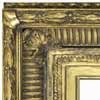
A small frame, of Art Nouveau design, in 23K gold. An aside, though I like the design, I'm not completely satisfied with the ... balance of this frame. In person, it looks better than in the photo, though.


A much larger frame, in a mid-nineteenth century, Neo-classical style. 5 inches high and 6 inches wide, with hand carved cross grain fluting, and applied, composition ornaments. 23K gold. There have been various posts concerning this frame under construction. Unusual for me, I'm quite satisfied with the way these have turned out, and these ( I made two) have had an enormous amount of problems; far beyond the normal problems that unusual frames are subject to.

8/17/11

Identification of leaf varieties.


The easiest method of identifying what kind of gilding one is looking at, is to look for the leaf lines; the spot where the leaves meet. In the above sample, the arrows are pointing at the lines of metal leaf (schlagmetal, dutch metal, composition leaf). When it is "gold" colored, it is a brass alloy, about 10,000th of an inch thick, and comes in a 5 1/2 inch square leaf. There are aluminum leaves; silver colored; copper leaf; copper colored, and various kinds of variegated leaf; multiple colors in one leaf.


Here, the leaf lines on matte, karat gold. The leaves come in slightly different sizes, depending on manufacturer, but are close to 3 1/4 inches square, and about 300,000th of an inch thick. This is the most common form of karat gold, though there is ribbon or roll gold, and there is a wide variety of karat weights and gold alloys, ranging from a white gold at 12K, to pure 24K leaves. For outdoor use; all those domes and statues, use a minimum of 23K. Another way of identifying genuine gold on picture frames, would be a distinctive difference between high spots and recessive areas of the frame, where the high spots have been burnished to a mirror like shine. This is called matte and burnish work, and requires the gold to be laid in the water gilt method, over a material called bole. Bole is mixed with glue, applied in multiple layers to the frame, polished, then gilt. When dry it is burnished with an agate stone, the most popular stone for burnishing. Bole comes in reds, yellows, blues, and blacks, with multiple shades in each color, and can often be seen where the leaf is worn, either through age or intention.


This is a brief explanation of what one is looking at; but this is a very ancient craft, and I touch on only the more common styles. There is gilding with tin foil; silver leaf lacquered to look like gold; bronze powders; bronze powder paint; and now, the non-tarnishing mica powders.

Size gilding, water gilding, glass gilding, engine turned gilding, and not least, gilding the lily.  8-)

And just to confuse the issue, there are many examples of lesser materials carefully finished to look like genuine gold.

Addendum: Metal leaf comes in other sizes as well, 6 1/4 square being the other common size.

Bron

8/15/11

The Importance of Art


"Morning Glory"

Here a brief article by Martha Nussbaum, a Professor at the University of Chicago, on the importance of art. Probably needs to be said more.

Bron

P.S. And more, here, from photographer, author , and artist, Kirk Tuck.

8/11/11

Laying Leaf


Two images showing the way I handle karat gold leaf. Top, the tip is held by the last two fingers of the right hand for cutting the leaf; bottom, the knife is now held by the last two fingers of the left hand. I work directly from the book of leaf. A book of leaf holds 25 leaves, between a tissue paper. I used to just insert a piece of mat board under the tissue, as a "cutting board" for cutting the leaf, but on a "bad day", this could be difficult with the mat board and the book all wanting to go in different directions. I've added a little touch that helps, though; double sided tape, framers ATG tape, holding the book to the mat board. I've used packaging tape as a surface on the mat board. The knife is one of the small, swiss army type knives, with a stainless steel blade; I've found they are the easiest to maintain a good edge on for cutting leaf. (The sign maker I worked with when first learning karat gold work, used the elongated fingernail, of his right hand, as a "knife". I did for a while, but kept breaking that nail.)

I'm patching "holidays, missed spots, holidays, get it" from the initial size gilding, so there is some cutting. 

In the bottom image , on the back of my left hand, some small specks of gold adhering to the minuscule amount of Vaseline on the back of my left hand, rubbed in there to provide a place for me to pick up a little tack for the tip, so it can pick up the leaf. Cut the leaf to the size needed, brush the back of my left hand with the tip, (flat, long haired brush for handling leaf) to get some tack to it, pick up piece of leaf, and apply. In an earlier post, where I'm speckled, when gilding I'm usually "glittery", as I use the right front of my shirt to clean and dry the tip.

On size work, I usually work with the book, almost like "patent gold" when I can, rolling the leaf onto the surface directly from the book.  No tip, no knife. Patent gold is a leaf slightly affixed to a sheet of paper that can be laid on the surface being gilt; useful for outdoor applications, as loose gold leaf is incredibly fragile.

Metal leaf, another post. And an aside, these are my techniques for an ancient craft, and they are not necessarily definitive. 

7/26/11

More variations on a theme.

Some frames in a mid-nineteenth century style, not exact reproductions. I've designed every aspect of them; all of the ornaments were chosen for reasons, or were designed and made by me for an overall design. They are in a style, but not reproductions. I will expand on that more when they are done, fitted to the paintings, and I have some images of the whole. 

One of the two frames "dominating" the studio at the moment. The burnished bits have been gilt, and the corner in the foreground has been burnished. Once the burnishing is done, I'll seal the rest of the frame with a colored shellac, a pale yellow, ocher like, though much softer. The matte areas, everything not water gilt, will be oil gilt. Water gilding allows the gold to be burnished into the bole, ( dark gray bits) producing a shiny, reflective surface. This contrasts with the matte areas. Oil gilding produces a more matte, matte gold than all water gilding.

More later, especially after I finish these two.  These two have had a higher than usual number of problems; none insurmountable, but every step seems to require some solutions, thought and remembrance. Well, the broker of the commission said, after stopping by to see them, that he thought they were going to be gorgeous. Glad he said it; I can't until they're done. (Being the one who wrestles the problems, it can be months after a project before I can see clearly that it turned out well).

If the liner seems "out of place", that's because it is; it has been raised on blocks inside it's outer frame for "access".  My work space is small; I need to be creative.

7/17/11

Variation on a theme


A version of the frame, here. I seldom follow antique designs faithfully; I do seem to want to go my own way.

Bron


Another image, of the frame above with it's twin, and the original antique.

7/10/11

Old Speckled Framer

Sometimes when spraying gesso, there will be a clog; a little something in the tubes. The easiest way to clear the clog is to gently place a finger over the nozzle so there is blow back, that will clear the clog, gently being the operative word. Done properly, this will clear the clog, and not blow a burst of gesso out the vent. Tah Dah! A tip of the hat to Moreland brewing and their delicious in the widget cans.

6/7/11

Really?

Whilst taking a small break, before starting to gesso one of the frames I'm working on, and checking some of the sites I frequent, I've noticed some "Zen yourself, redefine yourself" posts, and my response is puzzled; then sort of WTF. You can say fuck, it's alright. Here, some redemption.

Any way, as any kind of artist, you really need to let the barking of the dogs on the parade route wash off of you; not listen to Joe, but listen to yourself. Doesn't mean you can't reference the previous artists, or no plagiarism homage to other artists; just do your own work. Might not sell, but might be good work, better than doing only what will sell.

Carry on.

Bron

6/3/11

Big and bigger.


Current dust; a big frame in the background, and an even bigger frame foreground. The foreground one is on my assembly/joining rig.

6/1/11

5/29/11

Two Legged Rocking Chair

This is a small rocker, like a sewing rocker, or nursing chair.  28”h.  x  48” l.  x  23 1/2 w. 
The seat height is 18” at the front, 15” rear.  Hand carved, completely. Black Walnut. Laminated seat, legs and rockers. Until recently, I have seen only a few two legged rocking chairs. I'm posting about it because I realized I've not mentioned it's two legged aspect, on my other site. In another post I talk a little more about it.

Soon, I'm going to try and figure out when I made it???? Can't find the file on it.

Addenda: The chair above was probably made in early 1989, as it was in an exhibition in the fall of 89, and the one with arms, below was made in early 2002. I have records for the chair w/arms.

 
 Two Legged Rocker with Arms, 2002
Black Walnut
Private Collection

Probably time to make another.
Another Edit: The chair with arms was made in 2002, not as previously posted, 1992.

Ongoing Dust


I'm trimming the backs of some moldings I ordered for one of my current projects, a couple of 19th. c. reproductions. I usually make my own moldings, but sometimes, especially with big Victorian style frames, it is more efficient to order either custom or some existing pattern. These are an existing pattern that will be modified to meet my designs. Stephen Izzo, of Rhode Island, is the gentleman I use. He's very good.

I have made large coves, by angling the table saw fence, and making repeated passes, removing only a tiny fraction of material with each pass. It's labor intensive, and unless you spend a lot of time with hold downs, a little nerve wracking.  Or racking, if you are so inclined.